

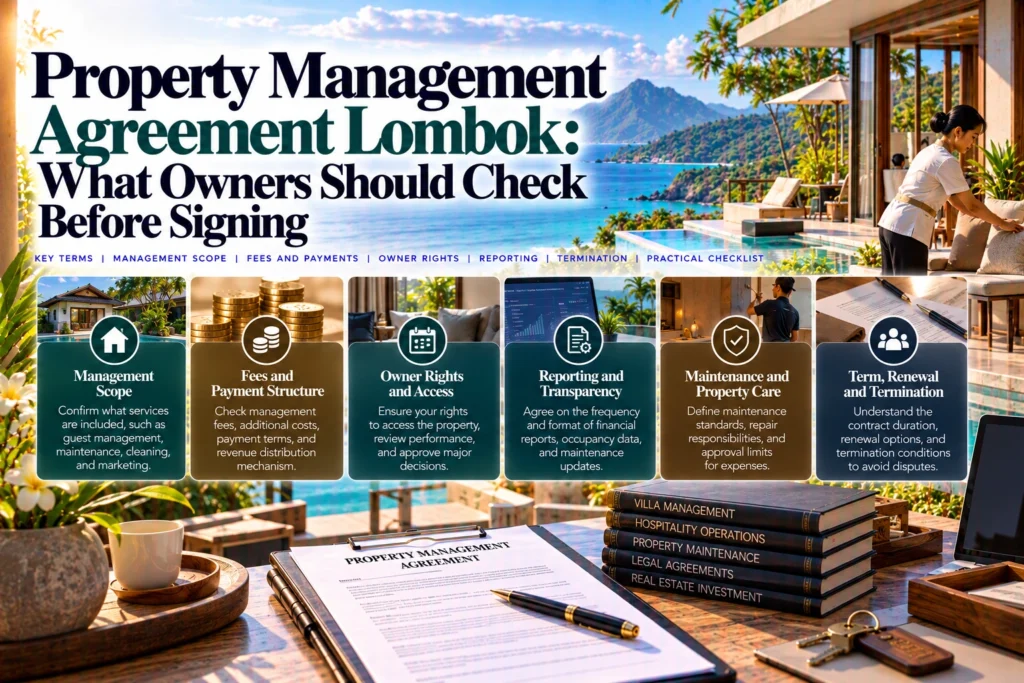
Property Management Agreement Lombok: A property management agreement should tell both sides exactly who controls day-to-day operations, how money moves, which decisions still belong to the owner, and what happens when the relationship ends. For a Lombok villa, guesthouse, or other managed property, the most useful agreement is not the longest one; it is the one that removes ambiguity around authority, revenue, expenses, maintenance, records, compliance, and exit.
Owners should therefore review the management contract separately from the property acquisition, lease, construction, or investment documents. A manager may be responsible for daily operations, but that does not automatically mean the manager should have unlimited authority over pricing, bank accounts, major repairs, staffing commitments, tax matters, or long-term commercial decisions.
For the broader planning framework, read our Notary Services Guide in Lombok. For help with your project, see our Notary services.
What a Property Management Agreement Should Actually Control
The agreement should begin with a precise description of the property and the services the manager is being appointed to perform. Avoid relying only on broad language such as “full management.” That phrase does not tell an owner whether the manager may sign vendor contracts, change nightly rates, issue refunds, recruit employees, approve repairs, collect deposits, or spend money without prior consent.
A practical scope section can separate three categories: actions the manager may take independently, actions permitted only within agreed financial or operational limits, and reserved matters that always require owner approval. This structure is especially useful where an owner is overseas and cannot approve routine matters every day.
Property Management Agreement Lombok: Core Clauses to Review
A property management agreement Lombok owners can actually use should cover more than the management fee. At minimum, the commercial drafting should address the manager’s mandate, booking and pricing authority, collection of guest revenue, permitted deductions, operating expenses, maintenance, staffing, owner-use periods, financial reporting, access to records, insurance responsibilities, complaint handling, termination, and handover.
The agreement should also identify the legal party acting as manager. Owners should verify the contracting entity rather than relying only on a resort, project, or trading name appearing in marketing material.
Define Authority Before Discussing Fees
A percentage management fee can look clear while the manager’s actual authority remains vague. Before negotiating the percentage, decide who controls pricing, discounts, minimum stays, booking channels, refunds, security deposits, complimentary stays, supplier appointments, staff engagement, and major purchases.
Reserved matters are useful for decisions that can materially affect the owner’s asset or cash flow. Examples can include capital works, borrowing, long-term supplier commitments, changes to the property’s operating concept, expenditure above an agreed limit, or settlement of substantial guest or vendor claims. These are drafting choices rather than universal legal thresholds, so the limits should reflect the property’s scale and operating model.
Make Revenue, Expenses, and Reporting Auditable
The contract should define the revenue base used to calculate any percentage fee. If a fee is calculated on “revenue,” specify whether that means gross booking receipts, revenue after platform commissions, revenue after taxes, or another agreed figure.
Owners should also establish where guest money is received, who controls the account, when the manager may deduct expenses, and when the balance is remitted. Monthly reporting is more useful when the agreement states what the report must contain, such as booking revenue, refunds, channel commissions, payroll or staffing costs, utilities, maintenance, management fees, taxes collected or paid where applicable, and supporting invoices for material expenses.
The contract should state how long financial and operational records remain available to the owner and whether the owner can request supporting documentation. This turns a general promise of “transparent reporting” into an operational obligation that can be checked.
Set Maintenance and Emergency Spending Limits
Routine maintenance and emergency works should not be treated identically. A manager may need authority to resolve a water leak, electrical fault, security problem, or guest-safety issue immediately, while non-urgent improvements can wait for owner approval.
A useful agreement can therefore set separate rules for routine maintenance, emergency expenditure, preventive maintenance, replacement of furniture or equipment, and capital improvements. It should also address whether the manager may use related-party suppliers and, if so, what disclosure or approval is required.
Indonesian Language and Foreign-Party Agreements
Language is not merely a presentation choice. For agreements involving an Indonesian private institution or Indonesian citizen, Presidential Regulation No. 63 of 2019 requires Bahasa Indonesia, while an agreement involving a foreign party is also written in that foreign party’s national language and/or English.
Article 26 of that regulation also allows the parties to agree which language will be used if interpretations differ between the Indonesian text and its foreign-language counterpart. For an overseas owner, this makes the bilingual drafting clause worth reviewing carefully rather than treating the English version as an informal convenience.
Contract Authority Is Not the Same as Business Licensing
A property-management contract answers a private-law question: what has the owner authorized the manager to do? Business licensing answers a different question: what legal permissions are required for the activities actually being carried out.
Indonesia’s current risk-based business-licensing framework is Government Regulation No. 28 of 2025, which replaced Government Regulation No. 5 of 2021. The OSS system states that risk-based business licensing groups activities into four risk levels and describes the NIB as the official business identity used to start or operate a business in Indonesia.
Because licensing follows the business activity and its risk profile under Government Regulation No. 28 of 2025, a property management agreement should not be treated as a substitute for any licensing required for the activities actually carried out by the operating party. The relevant checks depend on the business model, KBLI classification, services offered, property use, and which entity is legally operating them.
The agreement should therefore allocate responsibility for maintaining applicable business licences and approvals, responding to government requests, keeping operating data current, and informing the owner if a licence or approval is suspended, changed, or no longer suitable for the actual activity. That allocation does not itself determine what licences are legally required, so the operating model should be checked separately before signing.
Termination, Handover, and Exit Protection
Many management disputes become difficult only after termination. The agreement should say how either party may terminate, whether a cure period applies to breach, what happens to future bookings, and how quickly operational control must be returned.
The handover clause can cover keys, booking-platform access, social-media access used for the property, guest records where lawfully transferable, supplier information, financial records, deposits, outstanding invoices, inventory, employee-related information, and passwords or system credentials belonging to the property operation.
Future bookings deserve special attention. The contract should specify who services reservations accepted before termination, who holds advance payments, who bears refunds or relocation costs, and how commissions or management fees are treated after the termination date.
Pre-Signing Checklist for Lombok Owners
Before signing, confirm that:
- the correct owner and management entities are named
- the property and managed areas are clearly identified
- the manager’s authority is specific rather than described only as “full management”
- owner approval thresholds are written down
- pricing, discounts, refunds, and booking-channel authority are allocated
- the management-fee calculation base is defined
- revenue collection, permitted deductions, payment timing, and bank access are clear
- reporting content and supporting-document access are defined
- routine, emergency, and capital expenditure follow separate rules
- staffing and vendor appointment authority is allocated
- applicable licensing responsibility is assigned without assuming the contract itself creates a licence
- Bahasa Indonesia and any foreign-language version are prepared consistently with the parties involved
- termination, future bookings, money, records, and system access are covered by a detailed handover process
Conclusion
A good Lombok property management agreement is primarily a control document. It should make clear what the manager can do, what the owner still controls, how revenue and expenses can be verified, how the property is maintained, who handles regulatory responsibilities, and how management ends without leaving bookings, funds, records, or access credentials unresolved.
Owners should match the drafting to the actual operating structure rather than copying a standard resort-management template. The property type, contracting parties, revenue flow, manager’s authority, foreign-party involvement, and licensed activities can all change which clauses deserve the closest review.
Review the Agreement Before Operational Control Changes Hands
If you are preparing or reviewing a management arrangement for a Lombok property, Lombok Legal ID can assist with contract, notary, PPAT, and business-setup matters within its stated service scope.
A tailored review is particularly useful where the agreement combines foreign and Indonesian parties, revenue-control authority, long-term management rights, operating-company responsibilities, or licensing obligations.
FAQ – Property Management Agreement Lombok
Is a property management agreement the same as a lease agreement?
No. A management agreement normally appoints a manager to operate or administer property on the owner’s behalf, while a lease typically grants possession or use rights to a tenant for an agreed period. The actual legal effect depends on the wording and commercial structure, so the title of the document alone is not decisive.
Can a Lombok property management agreement be written only in English?
Where the agreement involves an Indonesian private institution or Indonesian citizen, Presidential Regulation No. 63 of 2019 requires Bahasa Indonesia. If a foreign party is involved, the agreement is also written in that party’s national language and/or English. The parties should also address which language controls if interpretations differ.
Should the manager be allowed to receive all guest revenue?
That is a commercial decision, not a default rule. If the manager receives guest money, the agreement should define the receiving account, permitted deductions, remittance schedule, reporting, supporting records, and the owner’s access or audit rights.
Does signing a management agreement give the manager the licences needed to operate the property?
No. Contractual authority and business licensing are separate issues. The operating party’s actual activities should be checked against the current OSS risk-based licensing framework and any sector-specific requirements that apply to the business model.
References & Sources
- Presidential Regulation No. 63 of 2019 on the Use of Indonesian Language — peraturan.bpk.go.id
- Government Regulation No. 28 of 2025 on Risk-Based Business Licensing — peraturan.go.id
- OSS Risk-Based Business Licensing System — oss.go.id