

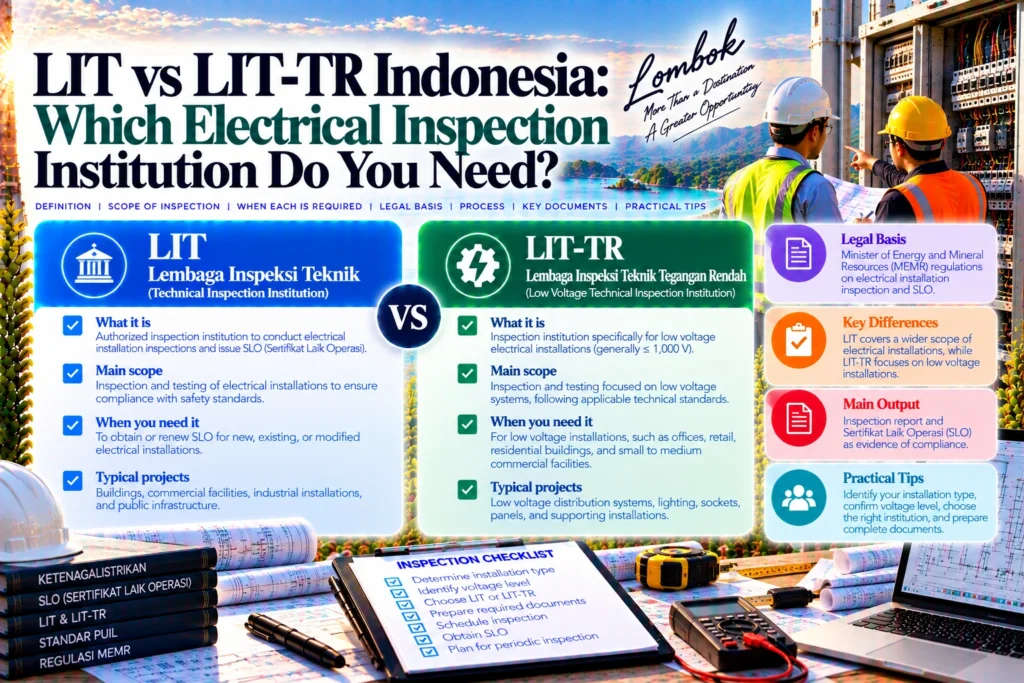
LIT vs LIT-TR Indonesia: The answer to LIT vs LIT-TR Indonesia depends primarily on the electrical installation being certified. LIT-TR is the dedicated route for low-voltage utilization installations, while LIT is used for the other regulated inspection routes, including high- and medium-voltage utilization installations and relevant power-supply installations.
Under Minister of Energy and Mineral Resources Regulation No. 12 of 2021, both Lembaga Inspeksi Teknik (LIT) and Lembaga Inspeksi Teknik Tegangan Rendah (LIT-TR) are recognized electricity inspection institutions, but the regulation assigns them to different installation-certification routes.
The official BPK regulatory database currently lists Minister of Energy and Mineral Resources Regulation No. 12 of 2021 as in force and records that it revoked the previous Regulation No. 38 of 2018.
The correct decision is therefore not which institution type is better. It is which institution type is authorized for the voltage and installation category you actually need to certify.
For the broader planning framework, read our Business Certification Guide in Lombok. For help with your project, see our Business Certification services.
What LIT Handles
Lembaga Inspeksi Teknik is the inspection route used for installations outside the dedicated low-voltage utilization framework. In practical SLO planning, that includes power-supply installations and high- or medium-voltage utilization installations within the applicable certification scope.
For high-voltage and medium-voltage utilization installations, Article 32 of Regulation No. 12 of 2021 requires the installation owner to submit the SLO application to a Lembaga Inspeksi Teknik.
The application data for this route includes the owner’s relevant licensing or identity information, installation location with coordinates, installation type and capacity, installation and layout drawings, a single-line diagram, specifications for major equipment, and the technical standards used.
High- and Medium-Voltage Utilization Installations
A commercial property can have a low-voltage internal distribution system while also receiving electricity through medium-voltage equipment. That is why owners should identify the exact installation segment being certified before selecting the inspection institution.
For a medium-voltage utilization installation, the SLO route is not changed merely because the end-use building is a hotel, factory, office, or shopping facility. The voltage and regulated installation category control the certification route.
The same principle applies to high-voltage utilization installations. Owners should not assume that an institution known for household or ordinary low-voltage SLO work automatically covers the higher-voltage installation that requires certification.
What LIT-TR Handles
Lembaga Inspeksi Teknik Tegangan Rendah has a narrower and very specific role: certification of low-voltage electricity-utilization installations.
For low-voltage utilization installations, Articles 40 and 41 of Regulation No. 12 of 2021 require the installation to have an SLO and direct the owner to submit the certification application to a Lembaga Inspeksi Teknik Tegangan Rendah.
In current implementation guidance, the Ministry of Energy and Mineral Resources continues to describe LIT-TR as the institution that performs certification of low-voltage utilization installations.
Low-Voltage SLO Inspection and Testing
Article 43 of Regulation No. 12 of 2021 assigns LIT-TR to inspect and test low-voltage utilization installations and to issue the SLO when the installation satisfies the applicable certification requirements.
For the LIT-TR route, Article 43 of Regulation No. 12 of 2021 provides that inspection, testing, and SLO issuance are completed no later than three working days after a complete and correct application is received.
That three-day provision should not be interpreted as a promise that every installation will receive an SLO within three days regardless of condition. The application must first be complete and correct, and the installation must satisfy the inspection and testing requirements.
NIDI and Application Records
The current official low-voltage SLO service procedure requires the application file to include the installation owner’s identity, installation location, installation type and capacity, installation drawing or single-line diagram, and installed equipment information.
The same official low-voltage SLO procedure states that the completeness of the SLO application documentation is recorded through the installation’s NIDI.
For owners, this means the institution choice should come after identifying the correct installation and confirming that the installation records correspond with what will actually be inspected.
LIT vs LIT-TR Indonesia Decision Matrix
The following comparison is designed to route the installation to the appropriate inspection framework rather than rank one institution type over the other.
| Decision point | LIT | LIT-TR |
|---|---|---|
| Core role | Inspection and certification within the non-low-voltage-specific installation routes | Inspection and certification of low-voltage utilization installations |
| High-voltage utilization installation | Applicable route | Not the dedicated route |
| Medium-voltage utilization installation | Applicable route | Not the dedicated route |
| Low-voltage utilization installation | Not the normal dedicated route | Applicable route |
| Typical SLO applicant | Power-supply license holder or owner of relevant high- or medium-voltage utilization installation | Owner of a low-voltage utilization installation |
| Main decision factor | Installation category and accredited inspection scope | Low-voltage utilization classification and accredited inspection scope |
The matrix shows why the two institution types should not be treated as interchangeable. Start with the physical installation and its voltage category, then identify an authorized institution whose actual certification scope covers that installation.
Do Not Choose by Company Name Alone
The name of an inspection company is less important than whether its current authority and accredited scope match the installation. A provider may operate in the electricity-certification sector without necessarily covering every type of generation, transmission, distribution, high-voltage, medium-voltage, and low-voltage installation.
Before appointing an inspection institution, give it the exact installation category, voltage level, capacity, location, and intended SLO scope. Ask for confirmation that the relevant installation falls within its authorized inspection coverage.
Avoid describing the project only as ‘electrical inspection’. That phrase is too broad to determine whether the LIT or LIT-TR framework is the right route.
Practical Routing Scenarios
House or Small Commercial Premises
A conventional low-voltage utilization installation serving a house, shop, small office, or similar premises generally belongs to the LIT-TR route because the installation being certified is a low-voltage utilization installation.
Hotel or Larger Commercial Building
Do not classify the entire project from the building type alone. A hotel may contain low-voltage utilization installations while also using medium-voltage receiving or distribution equipment. Each regulated installation segment should be mapped before selecting the inspection route.
For businesses working through broader electrical-sector company compliance, the existing Lombok Legal ID guide on SKTTK and SBU JBTL technical-personnel requirements addresses a separate company and personnel certification layer rather than SLO inspection.
Medium-Voltage Industrial Installation
Where the installation being certified is a medium-voltage utilization installation, the Article 32 route points to LIT rather than LIT-TR. The owner should prepare the technical drawings, single-line diagram, equipment specifications, and applicable standards for the relevant inspection process.
Power-Supply Installation
Generation, transmission, and distribution installations sit within the broader LIT inspection framework rather than the dedicated LIT-TR route for low-voltage utilization installations. The exact accredited scope of the selected LIT still needs to match the installation being certified.
Conclusion
There is no universal winner in an LIT versus LIT-TR comparison. The correct choice is conditional on the installation.
Use LIT-TR when the installation requiring SLO certification is a low-voltage utilization installation. Use the appropriate LIT route for high- or medium-voltage utilization installations and the relevant power-supply installation categories. In either case, verify the institution’s current authority and scope before submitting the application, because the institution type alone does not prove that every electrical-installation category is covered.
Map the Electrical Certification Route Before Filing
If your business is reviewing electrical-sector compliance, company certification, or related licensing in Lombok, Lombok Legal ID can assist with business certification preparation and regulatory-document review.
For SLO inspection, first identify the installation category and voltage level so the application can be directed to the appropriate authorized LIT or LIT-TR rather than treating the two inspection routes as interchangeable.
FAQ LIT vs LIT-TR Indonesia:
What is the main difference between LIT and LIT-TR?
LIT-TR is specifically used for certification of low-voltage utilization installations. LIT is used for the other applicable electricity-installation inspection routes, including high- and medium-voltage utilization installations.
Which institution inspects a low-voltage installation for SLO?
Regulation No. 12 of 2021 assigns inspection, testing, and SLO issuance for low-voltage utilization installations to LIT-TR.
Which institution handles a medium-voltage utilization installation?
Article 32 of Regulation No. 12 of 2021 directs owners of medium-voltage utilization installations to submit the SLO application to a Lembaga Inspeksi Teknik.
Can the same inspection company handle both low- and medium-voltage installations?
Do not assume so from the company name alone. The owner should verify the institution’s current accreditation and authorized inspection scope for the specific installation category being certified.
How long does LIT-TR have to process a low-voltage SLO?
Article 43 provides a maximum of three working days for inspection, testing, and SLO issuance after a complete and correct application has been received.
Does choosing LIT or LIT-TR depend on the type of building?
Not primarily. The controlling issue is the electrical installation category and voltage. A hotel, factory, or commercial building may contain more than one installation segment and may therefore require separate routing analysis.
References & Sources
- Minister of Energy and Mineral Resources Regulation No. 12 of 2021 on Classification, Qualification, Accreditation and Certification of Electricity Supporting Services — gatrik.esdm.go.id
- Official Regulatory Status for Minister of Energy and Mineral Resources Regulation No. 12 of 2021 — peraturan.bpk.go.id
- Official Procedure for Registration of Low-Voltage Utilization Installation SLO — gatrik.esdm.go.id
- ESDM Encourages Businesses to Promote Electrical Safety — gatrik.esdm.go.id
Recommended Next Articles
- SKTTK and SBU JBTL technical personnel requirements — lomboklegalid.com