
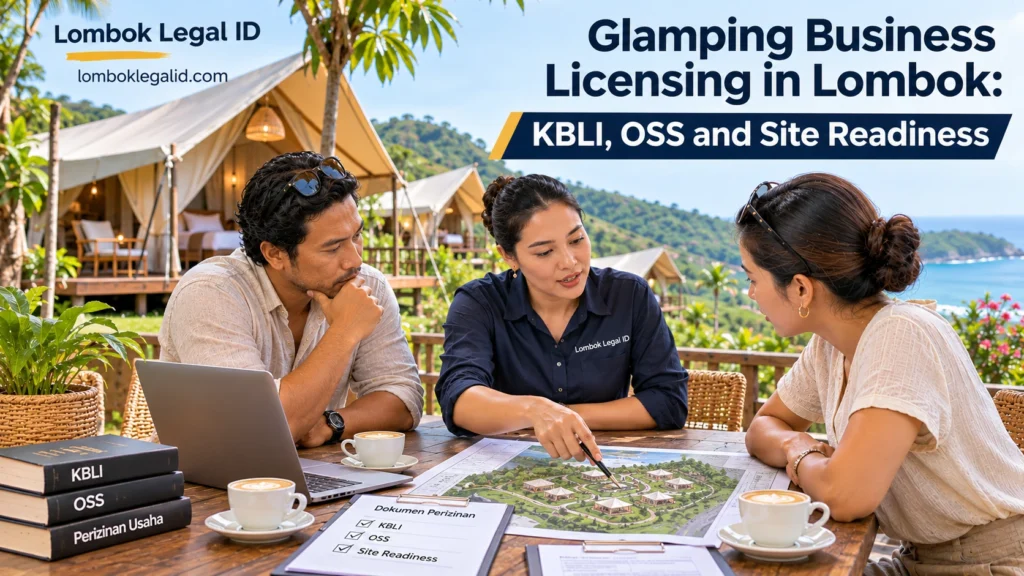
A commercial glamping business in Lombok should be assessed under Indonesia's accommodation licensing framework, but the correct classification depends on the accommodation actually offered. Luxury camping tents, semi-permanent safari tents, permanent cabins, and villa-style lodging are not necessarily identical business activities merely because they are marketed as glamping.
Indonesia's Government Regulation No. 28 of 2025 on Risk-Based Business Licensing provides the national framework for basic business requirements, business licenses, supporting business licenses, OSS services, supervision, and sanctions.
Before establishing a glamping site, investors should determine the accommodation model, verify the intended property use, and identify the current OSS classification and applicable technical requirements.
Does Glamping Need a Business License in Lombok?
An operator providing commercial accommodation to paying guests should establish the business licensing position applicable to its actual activity.
Glamping is a hospitality marketing term rather than sufficient evidence of one particular KBLI classification.
A business offering furnished tents in an outdoor camping environment may need a different assessment from an operator constructing permanent cabins with hotel-like facilities.
The type of accommodation, operating structure, and supporting services should be described before selecting a code or assuming that a particular permission is sufficient.
Glamping Business License Lombok: Identify the Accommodation Model
The first practical task is to explain what guests will occupy and how the site will operate.
Movable Camping Tents
A business may provide an outdoor area with furnished tents, shared bathrooms, simple reception facilities, and other camping-related amenities.
This model presents a clear reason to investigate the official camping accommodation classifications.
The operator should establish whether tents are movable, how long they remain installed, and which permanent structures support the business.
Semi-Permanent Luxury Tents
Some glamping concepts use safari-style tents, raised platforms, fixed bathroom units, permanent utility connections, and substantial supporting infrastructure.
The existence of fabric walls or a tent-shaped roof does not automatically resolve the building or business classification questions.
The operator should examine the physical structures and the actual guest accommodation service before reaching a conclusion.
Permanent Cabins and Villa-Style Units
Another glamping development may consist primarily of permanent cabins, bungalows, or standalone guest units with private bathrooms and hotel-like services.
Such a development should not automatically rely on the classification used for ordinary camping grounds without comparing the current detailed accommodation descriptions.
The investment decision should be based on the real structures and services rather than the project's branding.
Check KBLI 55300 and the OSS Accommodation Hierarchy
The official classification system provides an important starting point for camping-related accommodation businesses.
The official OSS description of historical KBLI 55192 covers outdoor accommodation using tents or caravans.
The official OSS conversion record identifies a one-to-one conversion from KBLI 2020 code 55192 to KBLI 2025 code 55300.
The current OSS hierarchy for KBLI 2025 subgroup 5530 identifies code 55300 for camping grounds, caravan stops, and caravan parks.
This makes KBLI 55300 an important classification to examine for a glamping business genuinely operating as camping-related accommodation.
Compare Camping and Other Accommodation Categories
The official OSS KBLI 2025 accommodation hierarchy distinguishes hotel and similar accommodation under group 551, other short-stay accommodation under group 552, and camping-related accommodation under group 553.
A proposed glamping business should be evaluated using the detailed descriptions relevant to its actual design and services.
The historical conversion from 55192 to 55300 does not mean every property branded as glamping must register that code.
Review the Detailed Activity Before Registration
The operator should prepare a concise business description showing the accommodation units, expected guest services, reception arrangements, shared facilities, and commercial activities.
This information can be compared with the current official OSS descriptions.
If the project combines substantially different accommodation formats or independently operated services, those differences should be assessed rather than hidden under one general marketing description.
Review OSS Licensing and Tourism Business Standards
Selecting a relevant KBLI is only one stage of the licensing review.
The official regulatory status record confirms that Government Regulation No. 28 of 2025 replaced Government Regulation No. 5 of 2021.
An older camping business checklist should therefore not be treated as conclusive evidence of current OSS procedures or requirements.
Identify the Applicable Licensing Instruments
The operator should examine the selected activity's current OSS requirements, business risk classification, and any supporting business authorizations relevant to the planned operation.
An NIB is an important business registration instrument, but its existence alone should not be treated as proof that the chosen premises and every supporting activity satisfy all applicable requirements.
The exact requirements must be determined from the current activity and the specific business circumstances.
Review Current Tourism Standards
The tourism business standards framework under Minister of Tourism Regulation No. 6 of 2025 addresses tourism business standards, licensing supervision, and administrative sanctions.
The official regulatory status record for Minister of Tourism Regulation No. 6 of 2025 confirms that it repealed Minister of Tourism Regulations No. 4 and No. 8 of 2021.
The appropriate tourism standards should be checked after identifying the actual accommodation classification and proposed commercial services.
No single universal facilities checklist should be assumed to apply to every luxury tent or cabin business without examining the relevant current standards.
Verify Land Rights and Spatial Compatibility
A suitable accommodation concept does not establish that a particular parcel may be used for commercial glamping.
The spatial-planning framework under Government Regulation No. 21 of 2021 addresses spatial plans, spatial utilization conformity, spatial-use controls, and supervision.
Before committing to a site, investors should identify the exact parcel, land rights, access arrangements, intended development, and applicable spatial-planning information.
Examine Legal Control of the Land
The investor should establish whether the business will use owned land, leased land, or another legally documented arrangement.
The property agreement should be reviewed for permitted commercial use, construction or installation rights, access, supporting facilities, and the duration of the arrangement.
A lease allowing ordinary occupation should not automatically be interpreted as permission to construct permanent guest facilities or operate commercial accommodation.
Check the Actual Site Rather Than Nearby Businesses
A parcel near existing villas, hotels, or campsites is not automatically eligible for the same development.
The operator should verify the property's own spatial position and relevant planning conditions.
This review is particularly important when the development includes permanent infrastructure, roads, utility systems, and multiple accommodation units.
Assess Buildings, Sanitation and Site Infrastructure
Glamping developments may look lightweight while depending on substantial physical infrastructure.
The building administration framework under Government Regulation No. 16 of 2021 provides national rules concerning building administration and technical requirements.
The operator should examine the actual characteristics of guest structures and supporting buildings before assuming that every tent, platform, bathroom, or cabin is outside building approval requirements.
Tents, Platforms and Supporting Buildings
Review the proposed construction or installation of accommodation units, decks, reception facilities, kitchens, bathrooms, storage areas, and other structures.
The relevant technical questions depend on the construction design and actual use.
A movable tent and a permanent cabin should not automatically receive identical treatment merely because both are included in a glamping project.
Water Supply and Sanitation
The development plan should describe potable water arrangements, toilets, bathing facilities, wastewater management, and routine cleaning.
A remote or nature-based setting may create practical infrastructure constraints that should be resolved before opening to paying guests.
The applicable approvals and technical requirements must be checked against the actual project rather than inferred from the number of tents alone.
Access and Guest Safety
Consider the available road access, vehicle movement, lighting, pedestrian routes, weather exposure, and access for emergency assistance.
The operator should also assess how guest facilities are maintained during adverse weather and periods of high occupancy.
These are practical planning considerations and do not establish a universal statutory guest-capacity limit or technical approval threshold.
Check Food Service and Outdoor Guest Activities
Many glamping businesses combine accommodation with meals, recreation, and guided experiences.
The operator should describe which services are included with accommodation and which are separately commercialized.
Meals and Beverage Services
A glamping site may provide breakfast, shared dining, a restaurant, or catering through an independent operator.
The licensing position should be assessed according to who conducts the food-service activity and how the service is offered.
A camping accommodation classification should not automatically be treated as authorization for every independently operated restaurant or beverage outlet.
Outdoor Recreation and Excursions
Guest activities may include guided walks, equipment rentals, excursions, and other outdoor experiences.
The operator should identify whether these services are delivered directly or by separate providers.
Their business classifications and operating responsibilities should be reviewed according to the actual services, rather than assuming that accommodation registration covers every recreational activity.
Glamping Licensing Readiness Matrix
The following matrix helps investors identify the information required for an initial development review.
| Review area | Evidence to examine | Main decision question |
|---|---|---|
| Accommodation concept | Unit designs and guest service descriptions | Is the activity genuinely camping-related accommodation? |
| KBLI classification | Current official OSS descriptions | Is KBLI 55300 appropriate, or should another classification be reviewed? |
| Business operator | Company and business registration records | Who will operate the accommodation? |
| Land control | Ownership, lease, and relevant agreements | Does the operator have authority to use and develop the site? |
| Spatial compatibility | Parcel coordinates and current planning information | Is the proposed commercial use compatible with the location? |
| Guest structures | Tent, platform, cabin, and building designs | Which structures require technical or building review? |
| Sanitation | Water, toilets, and wastewater arrangements | Are the infrastructure and applicable requirements adequately addressed? |
| Access | Road and site circulation plans | Can guests, suppliers, and emergency services access the property? |
| Food service | Kitchen, dining, and operator arrangements | Does the project involve separately conducted food-service activities? |
| Recreation | Activity descriptions and provider agreements | Who conducts and is responsible for additional guest activities? |
| Tourism standards | Applicable activity-specific requirements | Which current standards apply to the selected classification? |
This matrix is an investor's preliminary review tool, not an official universal glamping permit checklist.
Example: Luxury Tents and Permanent Cabins at One Site
Consider a hypothetical investor planning a glamping business in Lombok with twelve furnished tents, four permanent cabins, a reception building, shared dining facilities, and guided outdoor activities.
The investor describes the entire development as luxury camping accommodation.
The first licensing question is whether the actual accommodation operation falls within the current camping-related classification or includes other lodging activities that require separate analysis.
The existing OSS conversion from historical KBLI 55192 to KBLI 2025 code 55300 provides a relevant starting point for the tent-based camping component.
However, the permanent cabins, reception building, sanitation systems, and supporting services should be reviewed according to their actual design and operation.
The property itself must also be assessed for land rights, spatial compatibility, access, and relevant development requirements.
If guided activities are operated by an independent company, that provider's business position should be examined separately.
This hypothetical example does not establish that the proposed site, accommodation classification, or structures have been approved.
Checklist Before Establishing a Glamping Business
An investor can organize the initial review through the following actions:
- Describe the intended accommodation concept and guest services.
- Identify whether units are movable tents, semi-permanent structures, cabins, or other lodging facilities.
- Compare the actual accommodation activity with current OSS classifications, including KBLI 55300 where relevant.
- Identify the legal entity that will operate the business.
- Review the current licensing instruments for the selected activity.
- Verify land rights and the operator's authority to develop the property.
- Examine parcel-specific spatial compatibility.
- Review guest structures, supporting buildings, and relevant technical requirements.
- Assess water supply, sanitation, access, and environmental considerations.
- Identify separately operated food, beverage, recreation, and other guest services.
- Review the applicable tourism business standards.
- Resolve material legal and technical issues before accepting commitments that depend on the development's readiness.
Conclusion
Glamping business licensing in Lombok depends on the actual accommodation facilities, operating structure, and property conditions.
KBLI 2025 code 55300 is an important classification to investigate for camping-related accommodation, particularly because official OSS records identify its conversion from historical code 55192. However, the commercial term glamping does not automatically determine the appropriate classification for every tent, cabin, or nature retreat.
Investors should combine accurate KBLI selection with a parcel-specific review of land rights, spatial compatibility, structures, infrastructure, tourism standards, and supporting services before developing or opening the property.
Review Your Glamping Business and Property Readiness
Planning a glamping site, luxury tent accommodation, or nature-based hospitality development in Lombok? Lombok Legal ID provides business setup, notary-related, and PPAT-related services relevant to reviewing company arrangements and property documentation.
Request a consultation to discuss the proposed accommodation activity, land arrangements, OSS classification questions, and documentation that should be examined before development or opening.
Before registering the glamping operation, discuss the accommodation model, site and proposed activity records through our NIB and OSS registration service.
The site review should also establish the applicable spatial conformity and development requirements.
Read Also: Company Setup Guide in Lombok: Entity Choice, OSS and Launch Planning
FAQ Glamping Business License Lombok
Does a glamping business need an OSS business license in Lombok?
A commercial accommodation operator should establish the applicable business licensing requirements under the current OSS framework. The correct activity classification and supporting requirements depend on the actual accommodation business rather than the commercial term glamping.
What KBLI code is relevant to glamping accommodation?
KBLI 2025 code 55300 is a relevant classification to examine for camping grounds and caravan-related accommodation. However, the appropriate code for a particular glamping business depends on whether its actual facilities and services match the current official description.
What happened to KBLI 55192?
The official OSS conversion record identifies a one-to-one change from historical KBLI 2020 code 55192 to KBLI 2025 code 55300. The current detailed activity description and applicable licensing requirements should still be checked.
Can permanent cabins use the same KBLI as luxury camping tents?
Not automatically. The relevant classification should be determined from the actual accommodation design and services. A permanent cabin operation may require examination of other accommodation descriptions rather than relying exclusively on the camping classification.
Do glamping tents need PBG?
The applicable building requirements depend on the characteristics of the actual structures and supporting facilities. A movable tent, permanent platform, bathroom building, and fixed cabin may present different technical questions. No universal exemption or approval requirement should be assumed without reviewing the design and current rules.
Can agricultural or undeveloped land be used for glamping?
The answer depends on the parcel's applicable spatial-planning position, land rights, and proposed commercial activity. The investor should verify the exact site rather than assume that vacant or scenic land is suitable for tourist accommodation.
Does glamping accommodation licensing cover restaurants and guided tours?
That cannot be assumed for every operating model. The investor should distinguish services included in the accommodation activity from separately conducted restaurant, recreation, and tour businesses, particularly where independent operators provide them.
Is glamping licensing the same as hostel licensing?
Not necessarily. Hostels and camping-related accommodation may fall under different current KBLI groups. The correct classification depends on the actual accommodation model and the relevant detailed OSS description.
What should be reviewed before investing in a glamping site?
Review the intended accommodation design, operator, current KBLI classification, land rights, site coordinates, spatial compatibility, proposed structures, access, sanitation, supporting activities, and the current tourism licensing requirements before committing to development.
References & Sources
- Government Regulation No. 28 of 2025 on Risk-Based Business Licensing — peraturan.bpk.go.id
- OSS Classification for Camping Grounds, Caravan Stops, and Caravan Parks — oss.go.id
- OSS KBLI 2025 Accommodation Classification — oss.go.id
- OSS KBLI 2025 Camping Grounds and Caravan Accommodation Subgroup — oss.go.id
- Minister of Tourism Regulation No. 6 of 2025 on Tourism Business Standards, Supervision, and Administrative Sanctions — peraturan.bpk.go.id
- Government Regulation No. 21 of 2021 on Spatial Planning Implementation — peraturan.bpk.go.id
- Government Regulation No. 16 of 2021 on Building Administration — peraturan.bpk.go.id
Recommended Next Articles
- hostel accommodation licensing and OSS registration in Lombok — lomboklegalid.com