
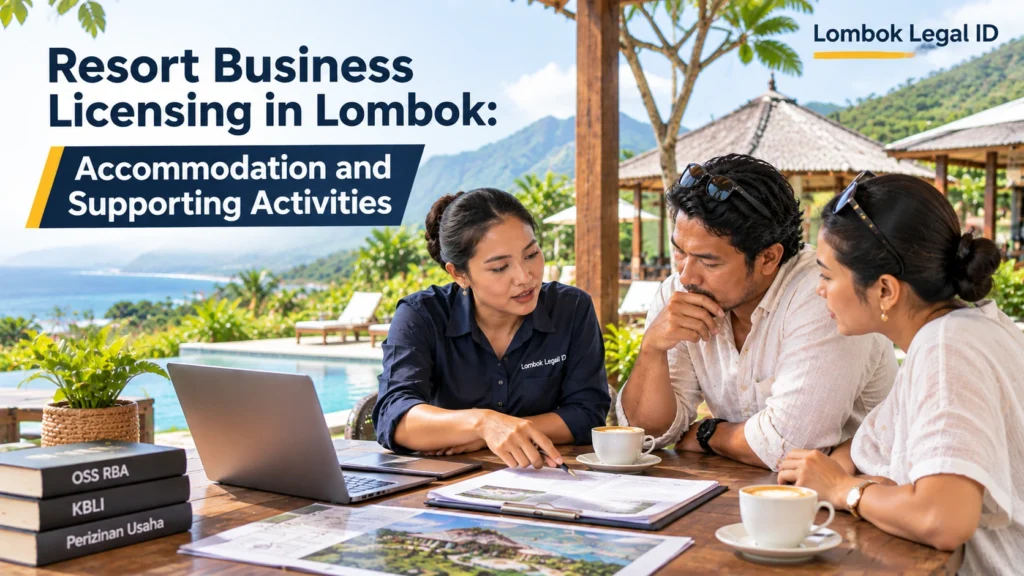
Resort business licensing in Lombok starts with identifying the actual accommodation activity and the other businesses operating within the resort. A resort may provide guest rooms or villas, restaurants, wellness services, recreational facilities, and event spaces, but the presence of those amenities does not automatically establish that one business classification covers every activity.
Indonesia's Government Regulation No. 28 of 2025 on Risk-Based Business Licensing establishes the national framework for basic requirements, business licensing, supporting business licenses, OSS services, supervision, and sanctions.
Investors should therefore prepare a clear description of the resort's accommodation model, operating entity, commercial facilities, and property development before deciding which licensing requirements apply.
How Resort Business Licensing Works in Lombok
The first question is what the resort business actually provides to customers.
A small resort with guest accommodation and shared leisure facilities may operate differently from a large development with independently managed restaurants, paid wellness services, water-based activities, and events open to outside visitors.
The legal review should distinguish facilities used to support accommodation from additional commercial activities conducted at the same property.
It is also necessary to establish who operates each service. A resort owner may run every facility directly, lease restaurant space to another company, or contract independent providers to deliver guest activities.
These arrangements can affect the business activity and documentation review.
Resort Business Licensing Lombok: Define the Operating Model
A useful resort licensing assessment begins with an activity map rather than a list of buildings.
For every facility, identify the operator, customers, services, payment arrangements, and whether the activity is included in the accommodation package or sold separately.
Accommodation as the Core Activity
Guest rooms, suites, villas, reception facilities, and housekeeping normally form the central accommodation offering of a resort.
The relevant business classification should reflect the actual lodging model and current OSS definitions.
Marketing the property as a luxury resort, boutique retreat, or eco-resort does not by itself establish a specific statutory classification.
Shared Guest Amenities
A resort may provide gardens, swimming pools, fitness areas, and other facilities as part of the guest experience.
The operator should record whether those facilities are exclusively available to staying guests, included in room packages, or independently marketed to paying visitors.
This distinction is useful when assessing whether an activity is part of the accommodation operation or requires a separate classification review.
Independently Operated Facilities
Some resorts lease space to restaurant, wellness, retail, or recreation operators.
The resort owner and the independent operator may have different responsibilities for business registration, premises use, operating documentation, and contractual compliance.
The licensing analysis should follow the actual legal operator rather than assume that every business at the property belongs to the hotel company.
Choose the Correct KBLI for Resort Accommodation
The accommodation classification should be established before the supporting activities are assessed.
The official OSS description of KBLI 2025 division 55 covers short-stay accommodation and recognizes that accommodation may be provided alone or together with food, beverage, or recreational facilities.
This description explains why a resort can combine lodging and amenities within one broader hospitality concept. It does not automatically establish that every separately operated business at the resort is covered by a single classification.
Review the Current Accommodation Hierarchy
The OSS KBLI 2025 accommodation hierarchy distinguishes hotel and similar accommodation activities under group 551, other short-stay accommodation under group 552, and camping-related accommodation under group 553.
A resort operator should compare the actual accommodation service with the current detailed activity descriptions before selecting a five-digit KBLI code.
The property design, guest service structure, and operating model are more useful starting points than the commercial word resort alone.
Do Not Rely Exclusively on Historical Codes
The official OSS conversion record for the former star-rated hotel code 55110 states that the historical code was divided into five KBLI 2025 classifications.
An investor using an older hotel's documents or an existing development plan should therefore verify the current classification before using the same code for a new project.
A conversion record identifies how classifications have changed. It does not independently determine a particular resort's licensing eligibility or risk category.
Check Restaurants, Wellness, Recreation and Events
A resort's supporting facilities should be reviewed according to their real commercial purpose.
Restaurants and Beverage Services
A resort may provide breakfast to staying guests, operate a public restaurant, manage a dedicated bar, or lease a dining outlet to an independent business.
The applicable business activity questions depend on who operates the service and how it is offered to customers.
A resort should not automatically assume that its accommodation registration resolves every restaurant, beverage-serving, or separately conducted retail activity.
Where alcoholic beverages are planned, their specific sales model and applicable authorization should also be assessed separately from the general accommodation classification.
Wellness and Spa Facilities
A resort may offer massage, spa services, fitness classes, or other wellness activities.
The operator should determine whether these are incidental guest amenities or independently marketed commercial services.
An external wellness provider working at the resort may require a different assessment from a service conducted directly by the accommodation operator.
The relevant licensing position should be determined from the activity itself rather than the presence of a spa room or treatment area.
Recreation and Guided Activities
Resort activities may include guided excursions, equipment rentals, recreational programs, and other guest experiences.
The operator should distinguish activities delivered directly by the resort from services offered by independent businesses.
The relevant questions include who receives payment, who provides the service, who is contractually responsible to the guest, and which registered business activities correspond to the operation.
Meeting and Event Facilities
A resort may have meeting rooms, wedding spaces, or outdoor areas used for private events.
Ordinary guest meetings may raise different business questions from a separately commercialized event venue or an event organization service.
The resort should identify the proposed event activity before assuming that the accommodation classification covers regular commercial event operations.
Review OSS and Tourism Business Standards
The applicable licensing requirements must be determined using the current activity classification and regulatory framework.
The official regulatory status record confirms that Government Regulation No. 28 of 2025 replaced Government Regulation No. 5 of 2021.
Older licensing guides should therefore not be relied upon as the final authority for a new resort application.
Identify the Applicable Business Licensing Instruments
The operator should review the current OSS requirements for each relevant business activity.
An NIB may form part of the licensing position, but the applicable instruments and any supporting business authorizations depend on the activity and its circumstances.
No universal package of licenses should be assigned merely because a development describes itself as a resort.
Review Current Tourism Standards
The tourism-sector framework under Minister of Tourism Regulation No. 6 of 2025 establishes tourism business standards, licensing supervision procedures, and administrative sanctions.
The official status record for Minister of Tourism Regulation No. 6 of 2025 confirms that it revoked Minister of Tourism Regulations No. 4 and No. 8 of 2021.
The appropriate sector standards should be examined against the actual resort accommodation classification and any additional activities governed by the relevant tourism framework.
The current regulation's existence does not, by itself, establish a specific facility requirement for every resort development.
Verify Land, Buildings and Environmental Readiness
A coherent business activity plan should be supported by an equally careful review of the proposed resort property.
Land Rights and Spatial Compatibility
The spatial-planning framework under Government Regulation No. 21 of 2021 addresses spatial plans, spatial utilization conformity, spatial-use controls, and supervision.
Before committing to a new resort development, the investor should establish the parcel coordinates, land-right position, intended commercial use, and relevant spatial-planning information.
The presence of nearby accommodation businesses should not be treated as proof that another parcel is suitable for the same development.
Building Functions and Documentation
The building administration framework under Government Regulation No. 16 of 2021 establishes the national regulatory basis for building administration and related technical requirements.
Resort operators should examine the intended functions of guest buildings, restaurants, service areas, and other facilities when reviewing applicable PBG, SLF, and technical documentation.
An existing building may require a different review from a newly constructed facility, particularly where its proposed use changes.
Environmental and Infrastructure Management
The environmental framework under Government Regulation No. 22 of 2021 addresses environmental approvals, water and air quality, waste management, supervision, and administrative sanctions.
A resort should evaluate its actual water demand, sanitation systems, wastewater arrangements, waste handling, access, and other infrastructure requirements.
The appropriate environmental documentation depends on the specific activity, location, scale, and applicable technical rules. A project should not automatically be classified as requiring AMDAL, UKL-UPL, or SPPL based solely on the word resort.
Resort Business Activity and Licensing Matrix
The following matrix helps investors map an integrated resort development before preparing individual licensing applications.
| Resort component | Operating model to identify | Main review question |
|---|---|---|
| Guest accommodation | Resort or accommodation company | Which current KBLI accurately describes the lodging activity? |
| Restaurant | Resort-operated or independent tenant | Is a distinct food-service activity relevant? |
| Bar | Resort-operated or third-party operator | What beverage activity and supporting permissions require verification? |
| Wellness facility | Included guest amenity or separate service | Does the actual activity require independent classification review? |
| Recreation | Direct operation or outside provider | Who supplies the service and holds operational responsibility? |
| Events | Guest meetings or commercial venue operation | Is a separate event-related activity being conducted? |
| Retail shop | Resort-operated or concessionaire | Who conducts the retail transactions? |
| Land and location | Owner, tenant, or developer | Are the property rights and spatial position suitable? |
| Buildings | Existing structures or new construction | Which building and functional documentation applies? |
| Environmental management | Entire development and its facilities | What environmental review corresponds to the actual project? |
The matrix is an investment planning tool, not an official universal resort licensing checklist.
Example: A Multi-Facility Resort in Lombok
Consider a hypothetical resort development consisting of guest villas, a central reception building, a restaurant, a wellness facility, and organized guest activities.
The accommodation company intends to operate the villas and reception directly. A separate business will lease the restaurant, while an outside provider will organize guided activities for guests.
The first assessment should establish the correct accommodation classification and current OSS requirements for the resort operator.
The leased restaurant requires examination of the independent operator's business activity and its contractual authority to use the premises.
The guided activity provider should be reviewed according to the actual service it sells and its relationship with the resort.
The investor should also examine the development's parcel-specific spatial compatibility, land rights, proposed building functions, infrastructure requirements, and applicable environmental pathway.
If the resort later opens a commercial event venue or a separately operated spa, its activity map should be updated and the relevant licensing questions reassessed.
This example is hypothetical and does not represent a particular approved resort or a verified development site.
Practical Steps Before Opening a Resort
An investor can organize the initial resort licensing review around the following actions:
- Define the accommodation concept and actual guest services.
- Identify the legal operator responsible for the resort business.
- Compare the accommodation model with the current OSS KBLI 2025 descriptions.
- List all restaurants, beverage outlets, wellness facilities, recreation services, and event activities.
- Identify which supporting facilities are operated directly and which belong to independent businesses.
- Determine the applicable OSS licensing requirements for each relevant activity.
- Review the current tourism standards matching the selected accommodation and supporting activities.
- Examine land rights, spatial compatibility, building functions, and existing documentation.
- Determine the appropriate environmental and infrastructure review for the actual project.
- Reconcile outstanding legal, technical, and contractual issues before opening the resort or committing to activities requiring further authorization.
Conclusion
Resort business licensing in Lombok should reflect how the entire development operates, not simply how the property is marketed.
Accommodation is usually the core service, but restaurants, wellness facilities, recreation, events, and independently operated businesses can introduce additional classification and compliance questions.
The strongest initial approach is to map each commercial activity, identify its operator, compare it with current OSS requirements, and verify the supporting property and infrastructure position. This helps investors distinguish what is part of the accommodation business from what requires further assessment before operation.
Review Your Resort Business Structure and Licensing Readiness
Planning a resort, boutique retreat, or multi-facility hospitality development in Lombok? Lombok Legal ID provides business setup, notary-related, and PPAT-related services relevant to reviewing business structures and property documentation.
Request a consultation to discuss the resort's proposed activities, operating entities, property arrangements, and licensing issues that should be examined before development or opening.
Before incorporating or restructuring a resort operator, discuss the accommodation and supporting activities through our business setup service.
For the wider sequence from entity choice to launch, work through the tourism business setup checklist.
Read Also: Company Setup Guide in Lombok: Entity Choice, OSS and Launch Planning
FAQ Resort Business Licensing Lombok
Does a resort need a separate business license from a hotel?
The answer depends on the actual accommodation activity and operating model. Resort is a commercial description that does not automatically determine a distinct statutory KBLI. The operator should identify the classification that accurately reflects its accommodation services and examine any additional commercial activities.
Which KBLI applies to a resort in Lombok?
The correct code depends on the resort's real accommodation category. The current OSS KBLI 2025 hierarchy includes hotel and similar accommodation activities under group 551, other short-stay accommodation under group 552, and camping-related accommodation under group 553. The operator should inspect the relevant detailed classification before registering the business.
Does one resort NIB cover every restaurant, spa, and recreational activity?
That should not be assumed. The operator should distinguish facilities forming part of the accommodation service from separately commercialized activities and independently operated businesses. Current OSS licensing requirements must be reviewed according to the actual activities.
Does a resort restaurant need its own KBLI?
The answer depends on the restaurant's commercial model, how it is operated, and whether the activity is already appropriately reflected in the business's registered scope. An independently operated restaurant should be assessed according to its own operator and activities.
Are recreational facilities automatically covered by resort accommodation licensing?
No automatic conclusion is appropriate. Facilities included as guest amenities may differ from separately marketed recreation services. Each commercial activity should be reviewed according to the actual operator, customer transaction, and current classification rules.
Does a resort need PBG and SLF?
The applicable building requirements must be evaluated using the proposed or existing structures, their functions, and the relevant building administration framework. The presence of accommodation facilities alone does not establish that all documentation has been completed.
Does every resort development require AMDAL?
A universal AMDAL requirement should not be assumed. The applicable environmental documentation depends on the actual activity, location, scale, and technical rules. The project's environmental pathway should be established through a specific assessment.
Can a resort lease its restaurant or spa to another company?
The commercial arrangement should be assessed through the property rights, operating agreement, and the independent company's business activities. Leasing a facility does not automatically transfer or resolve every business licensing responsibility.
What should an investor check before buying land for a resort in Lombok?
The initial review should cover land rights, seller authority, exact coordinates, spatial compatibility, intended development scale, access, building plans, environmental considerations, and the proposed legal operator before the investor relies on the site for a resort project.
References & Sources
- Government Regulation No. 28 of 2025 on Risk-Based Business Licensing — peraturan.bpk.go.id
- OSS KBLI 2025: Accommodation Services — oss.go.id
- OSS Hotel Classification and KBLI 2025 Conversion — oss.go.id
- Minister of Tourism Regulation No. 6 of 2025 on Tourism Business Standards, Supervision, and Administrative Sanctions — peraturan.bpk.go.id
- Government Regulation No. 21 of 2021 on Spatial Planning Implementation — peraturan.bpk.go.id
- Government Regulation No. 16 of 2021 on Building Administration — peraturan.bpk.go.id
- Government Regulation No. 22 of 2021 on Environmental Protection and Management — peraturan.bpk.go.id
Recommended Next Articles
- hostel accommodation licensing and OSS classification — lomboklegalid.com