

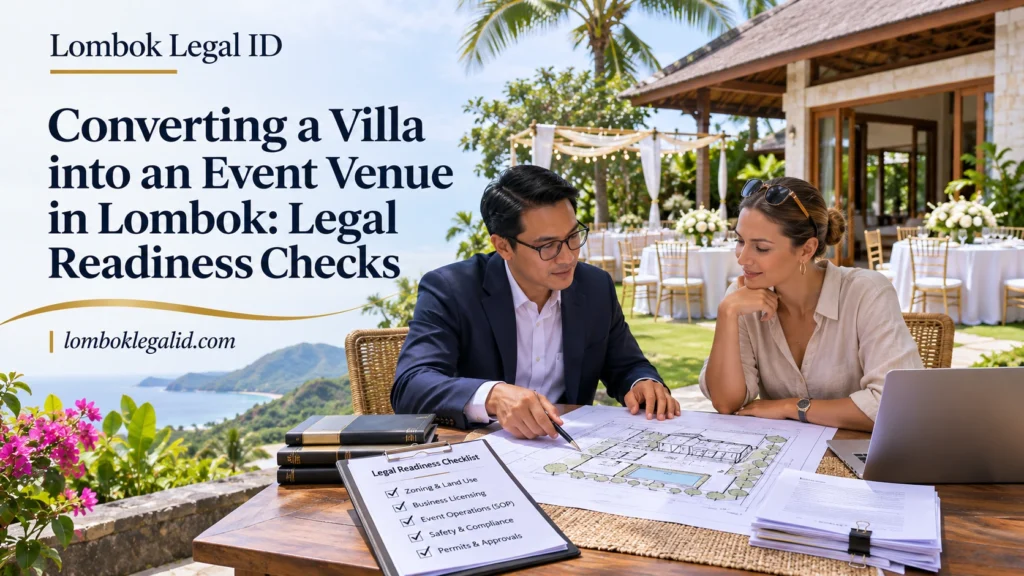
An existing villa in Lombok should not automatically be treated as ready for commercial events simply because it already hosts overnight guests. Converting a residential or accommodation property into a venue for recurring paid weddings, celebrations, meetings, or retreats may involve changes in building use, business activities, operational arrangements, and impacts on neighboring properties.
The owner should first establish what the villa is currently authorized and designed to do, then compare that position with the proposed event business.
Indonesia's Government Regulation No. 16 of 2021 on Building Administration establishes the regulatory framework for building administration, building functions, classifications, and technical requirements.
The key question is not whether the property looks attractive as a wedding venue. It is whether the existing legal documentation and physical premises support the intended commercial use.
Can an Existing Villa Become a Commercial Event Venue?
A villa may potentially be adapted for events, but the feasibility of that conversion depends on the specific property, the nature of the proposed events, and the applicable requirements.
The owner should distinguish three situations: occasional private gatherings by occupants, incidental events associated with normal accommodation services, and recurring commercial venue rental to outside customers.
These arrangements may differ substantially in visitor numbers, operating hours, services, equipment, and the use of the property.
A villa advertised for short-term accommodation should not automatically be assumed to have the same business classification or building function as a dedicated commercial event venue.
Villa Event Venue Conversion Lombok: Review the Existing Use
The first stage is to understand the property's current legal and operational position.
Identify the Existing Building Function
Obtain the relevant building approval documentation, available plans, and any records describing the building's approved function.
A residence, accommodation building, and commercial assembly facility may have different technical and operational characteristics.
The building-function provisions under Government Regulation No. 16 of 2021 require proposed changes in function or classification to be assessed against the applicable administrative and technical requirements and approval procedures.
The official status record for Government Regulation No. 16 of 2021 confirms that it repealed Government Regulation No. 36 of 2005.
Owners should therefore use the current building framework when investigating a proposed change rather than rely exclusively on historical permit terminology.
Define What the Conversion Actually Involves
A property owner planning only occasional small meetings may have a materially different proposal from an operator intending to host regular weddings with external guests, catering equipment, live music, and temporary stages.
Describe the actual event types, expected attendance, frequency, commercial arrangements, and proposed alterations to the site.
This description will determine which legal and technical questions need further investigation.
Check Building Function, PBG and Existing Documentation
The property's existing PBG or other historical building documentation should be examined in relation to the intended new use.
An existing approval does not automatically establish that every additional commercial activity or physical alteration is covered.
Compare the Approved and Proposed Functions
Review whether the proposed event use changes how the building is occupied, the number of people expected to gather, the areas used, or the technical demands placed on the premises.
The assessment should distinguish ordinary use of existing spaces from a material conversion affecting the building's documented function or classification.
Where a change is identified, the owner should obtain qualified advice on the applicable approval process and technical standards.
Review Physical Alterations
A villa conversion may involve new toilet facilities, guest circulation routes, parking areas, kitchens, stages, decks, lighting installations, or changes to existing rooms.
Those works should be assessed according to their actual design and purpose.
The fact that an alteration is described as temporary or decorative does not automatically remove the need for technical review.
Establish Defensible Event Capacity
The maximum number of guests should not be determined solely by the property's garden size or a promotional estimate.
The operator should consider the building and site layout, available facilities, evacuation routes, safe access, and any applicable technical assessments.
No universal wedding venue capacity is assumed for all Lombok villas.
Review Spatial Compatibility and Business Licensing
Even where the building can physically accommodate gatherings, the proposed business activity must be assessed in relation to the property's location.
The spatial-planning framework under Government Regulation No. 21 of 2021 governs spatial plans, spatial utilization, conformity of proposed activities, and spatial-use controls.
An existing residential or accommodation use should not automatically be treated as evidence that a separate commercial event operation is compatible with the site's planning position.
Identify the Actual Commercial Activity
The operator should determine whether it will rent the venue, organize events, provide catering, operate accommodation, or combine several services.
The risk-based business licensing framework under Government Regulation No. 28 of 2025 covers basic requirements, business licenses, supporting business licenses, OSS services, supervision, and sanctions.
The official regulatory status record confirms that Government Regulation No. 28 of 2025 replaced Government Regulation No. 5 of 2021.
The current OSS classifications and requirements should be checked against the real services offered by the business.
Do Not Assume Existing Accommodation Licensing Covers Events
A villa may already operate as a short-stay accommodation business, but that fact alone does not establish that it can market itself as a recurring paid event venue.
The tourism-sector framework under Minister of Tourism Regulation No. 6 of 2025 addresses tourism business standards, licensing supervision, and administrative sanctions.
Its application depends on the relevant classified activity. The owner should identify whether the proposed events are incidental to accommodation or constitute an additional commercial operation requiring further review.
Examine Ownership, Lease and Venue Contracts
The ability to control or occupy a villa does not automatically establish unrestricted authority to use it for every commercial purpose.
Confirm the Property Owner's Authority
Where the villa is owner-operated, review the available land and building documents and any agreements affecting property use.
Where the villa is leased, the lease should be examined for limitations on commercial activities, subletting, alterations, public events, guest numbers, and use of common areas.
A tenant should not assume that permission to provide accommodation includes permission to convert the property into a venue for outside events.
Distinguish the Villa Owner from the Event Operator
The property owner, accommodation company, and event organizer may be different legal persons.
Their respective rights and responsibilities should be clear, particularly where bookings are accepted by one business and the premises are controlled by another.
Prepare Suitable Venue Agreements
Commercial event agreements should establish what the operator provides and which responsibilities belong to the customer, event organizer, caterer, and other contractors.
Relevant matters may include cancellation, deposits, approved attendance, use of equipment, property damage, restoration, vendor access, and compliance with site operating conditions.
These are practical contractual considerations rather than a statement that a single mandatory venue agreement format applies to all Lombok properties.
Assess Neighborhood and Operational Impacts
Recurring events can create demands that differ from ordinary villa accommodation, especially when guests who are not staying overnight visit the property.
Noise and Operating Hours
Live entertainment, sound equipment, rehearsals, and late-night gatherings may affect adjacent properties.
Operators should examine applicable local conditions and develop an appropriate sound-management plan before marketing the site for events.
No single Lombok-wide sound limit or universally applicable closing time is asserted here.
Parking and Access
Event attendance may increase vehicle movements beyond those expected from the property's ordinary accommodation activity.
Review site access, parking arrangements, supplier deliveries, pedestrian movement, and any practical constraints affecting neighboring roads or properties.
Sanitation, Waste and Temporary Facilities
Larger gatherings may require additional toilets, waste collection, water supply, catering infrastructure, and cleaning arrangements.
Temporary structures and equipment should also be evaluated according to their characteristics, installation, and intended use.
A well-managed operating plan can reduce practical risks, but it is not a substitute for any legally required approval or technical assessment.
Villa Conversion Readiness Matrix
The following matrix can help property owners identify what must be checked before advertising an existing villa as a commercial event venue.
| Review area | Existing evidence | Conversion question |
|---|---|---|
| Property rights | Certificate, lease, or ownership documents | Does the operator have authority to host paid events? |
| Building function | PBG and available building records | Does the intended event use change the documented function? |
| Spatial planning | Parcel coordinates and applicable planning information | Is recurring commercial event use compatible with the site? |
| Business activities | Existing OSS records and service descriptions | Are additional or changed activities relevant? |
| Attendance | Building layout and technical assessment | What guest numbers can the premises appropriately support? |
| Access and parking | Site plan and access arrangements | Can event traffic be accommodated? |
| Sound management | Proposed event schedule and equipment | What location-specific operational restrictions require review? |
| Food service | Kitchen, caterer, and restaurant arrangements | Who conducts the food service and under which business model? |
| Alterations | Proposed construction and equipment plans | What technical or building approval review is necessary? |
| Contracts | Venue terms, leases, and contractor agreements | Are commercial rights and responsibilities properly allocated? |
This matrix is a due-diligence planning tool, not an official universal permit checklist.
Example: Turning a Rental Villa into a Wedding Venue
Consider a hypothetical villa owner in Lombok who currently rents a property to overnight guests.
The owner wants to accept paid wedding bookings involving approximately 80 guests, external catering, amplified music, temporary decorations, and evening celebrations.
The owner's existing accommodation documents should not be assumed to authorize the proposed use merely because weddings would take place on the same property.
The review should begin with the villa's existing building function and documentation, then examine spatial compatibility and the commercial services the operator intends to provide.
The owner should also assess technical capacity, access, parking, sanitation, sound, and the terms of agreements with customers and contractors.
If the property is leased, the legal authority to conduct the new activity becomes an additional contractual question.
The project may be commercially attractive, but the decision to proceed should depend on the findings of the legal and technical review.
This example is hypothetical and does not establish approval for an actual Lombok property.
Checklist Before Accepting Commercial Event Bookings
Before converting an existing villa into a recurring paid event venue, consider these steps:
- Obtain the villa's land, ownership, and existing building records.
- Establish the building's current documented function and classification.
- Describe the proposed events, expected attendance, operating hours, and services.
- Determine whether building alterations or changes in function require additional review.
- Examine the applicable spatial-planning position for the exact parcel.
- Review existing OSS activities and the business model for venue rental or event organization.
- Confirm that ownership or lease agreements permit the proposed commercial activity.
- Assess access, parking, sanitation, sound, and neighborhood impacts.
- Prepare clear booking and contractor agreements allocating relevant responsibilities.
- Resolve material legal and technical uncertainties before making commitments that depend on the venue's readiness.
Conclusion
Converting a villa into an event venue in Lombok requires more than adding wedding packages or renting existing outdoor space to clients.
The proposed use should be compared with the property's documented building function, spatial-planning position, business activities, and contractual arrangements.
The practical decision is whether the existing property can support the intended events lawfully and safely, and what must change before recurring commercial bookings begin. A documented conversion review helps owners identify those questions before making substantial investments or accepting obligations they may be unable to fulfill.
Review Your Villa's Readiness for Commercial Events
Planning to convert an existing villa into an event venue in Lombok? Lombok Legal ID provides business setup, notary-related, and PPAT-related services relevant to reviewing property documentation and commercial operating arrangements.
Request a consultation to discuss the villa's existing legal documents, proposed event activities, ownership or lease arrangements, and the matters that should be examined before conversion.
Before changing a villa’s operating model, discuss the entity, activity scope and required coordination through our business setup and licensing service.
The conversion review should be followed by an event venue licensing assessment.
Read Also: Company Setup Guide in Lombok: Entity Choice, OSS and Launch Planning
FAQ Villa Event Venue Conversion Lombok
Can I use my existing villa as a wedding venue in Lombok?
Potentially, but the answer depends on the property's existing legal use, building documentation, spatial compatibility, business activities, and proposed operations. An existing accommodation business should not automatically be treated as authorization for recurring paid weddings.
Does converting a villa into an event venue require a new PBG?
A universal answer is not appropriate without reviewing the property. Government Regulation No. 16 of 2021 provides the framework for building functions and changes. The owner should establish whether the proposal changes the documented function or classification and which approval procedure applies.
Is an existing villa rental NIB enough to organize commercial events?
Not necessarily. The owner should compare the current registered business activities with the actual proposed venue operation and determine whether additional or changed OSS activities and supporting requirements are relevant.
Can I convert a villa that I lease rather than own?
The lease and property rights must be examined. Permission to occupy or operate accommodation does not automatically establish contractual authority to alter the building, sublet event space, or conduct recurring commercial gatherings.
How many wedding guests may attend a converted villa?
No universal guest limit can be established solely from the property being a villa. Appropriate capacity depends on the building's documented function, layout, relevant technical assessments, available facilities, and applicable conditions.
Does a villa event venue need a separate noise permit?
The relevant requirements depend on the location, event format, sound arrangements, and applicable local rules. It would be inaccurate to assume one universal noise permit or numerical limit applies to every Lombok villa.
Are occasional family gatherings treated the same as paid commercial weddings?
Not automatically. The owner should distinguish private use from recurring commercial venue operations. The applicable business and property requirements depend on the substance of the proposed activities.
What should be checked before advertising a villa for weddings?
Review the existing building function, permitted use, business activities, contractual rights, guest capacity, access, parking, sanitation, sound management, and any necessary approvals or technical assessments.
References & Sources
- Government Regulation No. 16 of 2021 on the Implementation of the Building Law — peraturan.bpk.go.id
- Government Regulation No. 21 of 2021 on Spatial Planning Implementation — peraturan.bpk.go.id
- Government Regulation No. 28 of 2025 on Risk-Based Business Licensing — peraturan.bpk.go.id
- Minister of Tourism Regulation No. 6 of 2025 on Tourism Business Standards, Supervision, and Administrative Sanctions — peraturan.bpk.go.id