

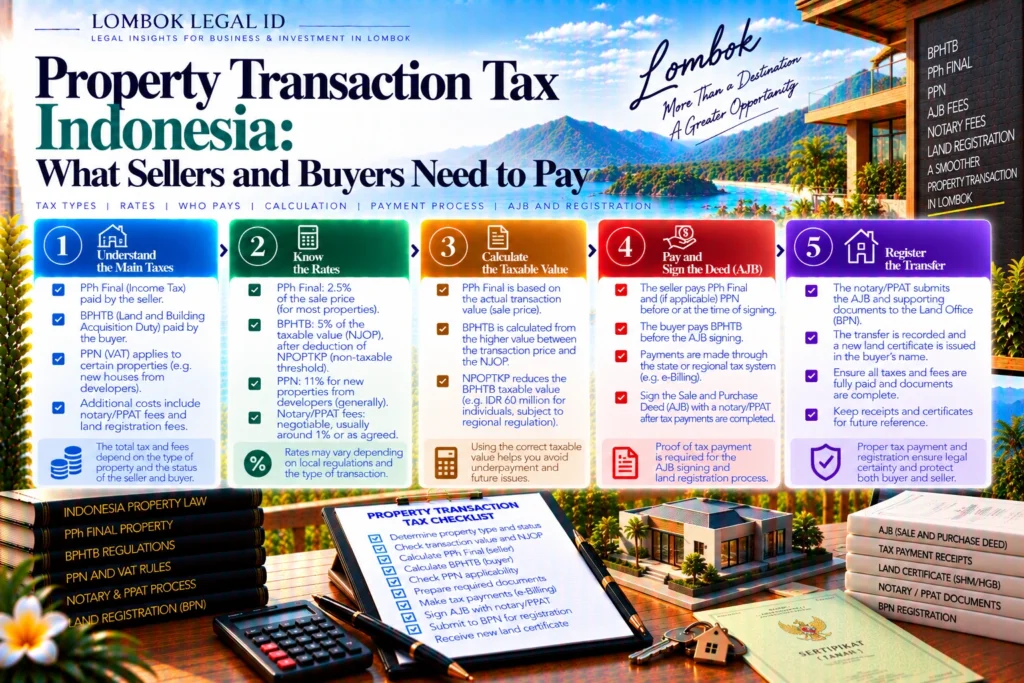
Property tax in an Indonesian sale is split across different parties and different tax systems. In a typical private-market transaction, the seller needs to review final income tax on the transfer, while the buyer needs to review BPHTB on acquiring the land or building right. VAT is a separate issue that becomes relevant only in particular transaction structures, such as certain taxable business or developer sales.
That means there is no reliable single percentage that answers every property transaction tax Indonesia question.
Property Transaction Tax Indonesia: The Short Answer
The seller-side framework remains Government Regulation No. 34 of 2016, which the official BPK database lists as in force. Article 1 provides that income received or obtained from transfer of land or building rights is subject to final income tax under the official regulation.
The buyer-side national framework is Law No. 1 of 2022, which the official BPK database lists as in force. Article 44 makes acquisition of land or building rights an object of BPHTB and expressly includes acquisition through sale and purchase under Law No. 1 of 2022.
For transaction planning, treat those as two separate calculations rather than adding a seller percentage and buyer percentage together without checking who legally bears each obligation.
Seller Tax — Final Income Tax on the Transfer
For an ordinary transfer outside the regulation’s special categories, Article 2 generally sets the final income-tax rate at 2.5 percent of the gross transfer value under Government Regulation No. 34 of 2016.
The regulation also contains different treatment for specified categories, including certain simple-house transactions by taxpayers whose main business is transferring property and specified public-interest acquisitions. The 2.5 percent figure should therefore be described as the ordinary rule, not a universal rate for every possible transfer.
What value is used for seller-side PPh?
For a sale not influenced by a special relationship, Article 2 uses the value actually received or obtained as the transfer value, while a related-party transfer uses the amount that should have been received or obtained under the same regulation.
That distinction matters where a property is being transferred between related companies, shareholders, family-controlled entities or other parties whose agreed price may not reflect an independent transaction. A nominal contract price should not automatically be assumed to be the final tax base in every related-party case.
When must the seller-side tax be paid?
Article 3 generally requires the transferor to pay the applicable final income tax before the deed, decision, agreement or auction minutes are signed by the authorized official under the regulation.
For a normal AJB transaction, this makes seller-side tax preparation a pre-signing issue rather than something that should first be considered after the PPAT appointment.
Buyer Tax — BPHTB on Acquiring the Property
BPHTB is the acquisition-side tax. Article 45 identifies the person or entity acquiring the right as the BPHTB taxpayer under the same law.
The calculation is not simply ‘purchase price multiplied by 5 percent.’ Article 48 calculates BPHTB by applying the applicable regional rate to the acquisition-tax base after subtracting the relevant non-taxable acquisition value under Law No. 1 of 2022.
In practical terms, the buyer needs to determine the applicable acquisition value, the local non-taxable acquisition value and the regional BPHTB rate before calculating the final liability.
Why there is no single Lombok BPHTB figure
Article 47 caps the BPHTB rate at 5 percent and requires the actual rate to be set by regional regulation, so the buyer’s exact liability must be checked under the regulation applicable where the Lombok property is located under Law No. 1 of 2022.
This is important because ‘Lombok’ is not one local-government tax jurisdiction. A property can be located in a different regency or in the City of Mataram, and the local rule should be checked for the actual property location before quoting a buyer-side figure.
For that reason, a transaction budget should not rely on a generic online calculator that assumes the same non-taxable threshold and rate for every property in NTB.
When does BPHTB become due?
For a sale and purchase, Article 49 places the BPHTB tax point at the date the sale-and-purchase binding agreement is made and signed under the national law.
That timing rule deserves attention where a transaction uses a PPJB before the later AJB. The buyer should not assume that BPHTB first becomes relevant only when the PPAT signs the final land-transfer deed.
The same Article 49 uses a different tax point for inheritance, namely when the heir or the heir’s authorized representative registers the inherited transfer with the land authority under Law No. 1 of 2022.
This is one reason an inherited property should be reviewed as an inheritance transaction first and a later sale transaction second. Lombok Legal ID’s inherited land sale guide covers that title-readiness stage separately.
Does VAT Apply to Every Property Sale?
No. VAT should not be added automatically to every private resale calculation. It requires a separate review of the seller, the property and the transaction structure.
A developer or other taxable-business transaction can involve VAT rules that do not apply in the same way to an ordinary private resale. Current policy also includes a temporary incentive for qualifying new residential property.
For qualifying new residential property in 2026, Minister of Finance Regulation No. 90 of 2025 provides a government-borne VAT incentive for eligible landed houses and apartment units. The regulation limits the eligible property to qualifying new, ready-to-occupy landed houses or apartment units with a sale price no higher than Rp5 billion under the 2026 incentive rules.
For a transaction meeting the regulation’s conditions, Article 7 provides government-borne VAT equal to 100 percent of the VAT due on the portion of the sale price up to Rp2 billion for an eligible home priced up to Rp5 billion under the 2026 incentive.
The incentive should not be treated as a permanent property-tax rule. It applies to the specified 2026 period and contains conditions concerning the property, buyer, transaction timing, first delivery and administrative compliance.
Inheritance, Gifts and Other Transfers Need Separate Tax Analysis
The word ‘property transfer’ covers more than a sale. Inheritance, gifts, exchanges, court decisions and corporate transactions can use different tax bases, exemptions, timing rules or supporting procedures.
A seller-side 2.5 percent sale example should therefore not be copied into an inheritance file without checking the rule for that specific transfer. Likewise, buyer-side BPHTB timing differs between an ordinary sale and inheritance.
This distinction is particularly important where inherited land is sold soon after succession. The inheritance registration and its tax consequences should be separated from the later sale and its own seller and buyer tax obligations.
Seven Tax Checks Before Signing a Property Deal
Before finalizing the transaction documents, review these points:
- Identify the transfer type. Confirm whether the deal is a normal sale, inheritance, gift, exchange, related-party transfer or another legal event.
- Identify the seller-side PPh category. Do not assume the ordinary 2.5 percent rate applies without checking the transaction category and any available exception.
- Confirm the seller-side tax base. Review the agreed transfer value and whether a special relationship affects the amount used for tax purposes.
- Determine the correct BPHTB jurisdiction. Use the regional rule for the actual regency or city where the property is located.
- Calculate BPHTB using the local non-taxable amount. Do not multiply the purchase price by a generic percentage without applying the correct local formula.
- Check whether VAT is relevant. Review whether the seller is making a taxable business or developer supply and whether a current incentive applies.
- Align tax timing with the transaction documents. PPJB, AJB, inheritance registration and other transfer documents can trigger obligations at different stages.
A useful transaction budget should therefore show at least three columns: seller taxes, buyer taxes and transaction-specific taxes or incentives. That structure makes it easier to see which amount belongs to which party and when it becomes relevant.
Once the transaction and the parties have been identified, use the seller final-income-tax guide and the Lombok buyer BPHTB checklist to prepare the two sides of the tax file separately. Keep those records aligned with the signing and registration sequence rather than treating the transaction as one combined tax payment.
Conclusion
Property transaction tax Indonesia is not one tax and not one nationwide percentage. In an ordinary sale, the seller generally reviews final income tax under PP No. 34 of 2016, while the buyer reviews BPHTB under Law No. 1 of 2022 and the applicable local regulation.
The buyer-side calculation is especially location-sensitive because the national law sets a maximum rate and calculation framework while regional rules determine the operative rate and non-taxable amount. VAT adds another layer only for relevant transaction structures, and qualifying new residential purchases can access a specific 2026 government-borne VAT incentive if all conditions are met.
For owners and investors, the safest approach is to classify the transaction first, allocate each tax to the correct party, verify the local BPHTB rule and settle the tax analysis before the transaction documents are signed.
Review the Tax Position Before the Property Signing
If you are buying or selling property in Lombok, Lombok Legal ID can assist with PPAT-related transaction documentation and financial-compliance review based on the actual property, parties and transfer structure.
A pre-signing review can help separate seller PPh, buyer BPHTB and any transaction-specific VAT issue before the amounts are built into the purchase agreement or AJB process.
For help coordinating the company records and supporting documents discussed here, review our Financial Consultant service and agree the scope for your project.
Read Also: Business Finance, Accounting and Tax Guide for Lombok Companies
FAQ Property Transaction Tax Indonesia
Who pays tax when property is sold in Indonesia?
In a typical sale, the transferor or seller reviews final income tax on the transfer, while the buyer or acquirer is the BPHTB taxpayer. VAT requires separate analysis and does not automatically apply in the same way to every private resale.
What is the usual seller-side tax rate for an ordinary property sale?
PP No. 34 of 2016 generally applies a 2.5 percent final income-tax rate to an ordinary transfer outside its special categories and exceptions.
Is BPHTB always 5 percent?
No. Law No. 1 of 2022 caps the rate at 5 percent, but the actual rate is set by regional regulation. The calculation also uses the applicable non-taxable acquisition value before the local rate is applied.
Is BPHTB the seller’s tax?
No. The national law identifies the person or entity acquiring the land or building right as the BPHTB taxpayer.
When does BPHTB become due for a property sale?
Under Article 49 of Law No. 1 of 2022, the tax point for a sale and purchase is the date the sale-and-purchase binding agreement is made and signed.
Does VAT apply when buying a house in Indonesia?
VAT can be relevant in taxable business or developer transactions, but it should not be assumed for every private resale. In 2026, qualifying new landed houses and apartment units can receive a government-borne VAT incentive under PMK No. 90 of 2025.
Is inherited property taxed the same way as an ordinary purchase?
No. Inheritance has its own BPHTB timing rule and succession process. A later sale of inherited property is a separate transaction with its own seller and buyer tax analysis.
References & Sources
- Government Regulation No. 34 of 2016 on Final Income Tax for Transfers of Land and Buildings — peraturan.bpk.go.id
- Official Text of Government Regulation No. 34 of 2016 — peraturan.bpk.go.id
- Law No. 1 of 2022 on Financial Relations Between the Central Government and Regional Governments — peraturan.bpk.go.id
- Official Text of Law No. 1 of 2022 on Central-Regional Financial Relations — peraturan.bpk.go.id
- Minister of Finance Regulation No. 90 of 2025 on Government-Borne VAT for Landed Houses and Apartment Units in 2026 — pajak.go.id