If an OSS Standard Certificate for a medium-high-risk activity is still marked not yet verified, the business should not treat that document as authority to begin operational or commercial activity. Under the current rules, that status provides limited legality for preparation while the applicable business standards still have to be fulfilled and verified.
The current overarching framework is Government Regulation No. 28 of 2025, which has been in force since 5 June 2025 and revoked Government Regulation No. 5 of 2021.
The current implementing regulation is Minister of Investment and Hilirisasi/BKPM Regulation No. 5 of 2025, which the issuing authority lists as in force and records as promulgated on 2 October 2025.
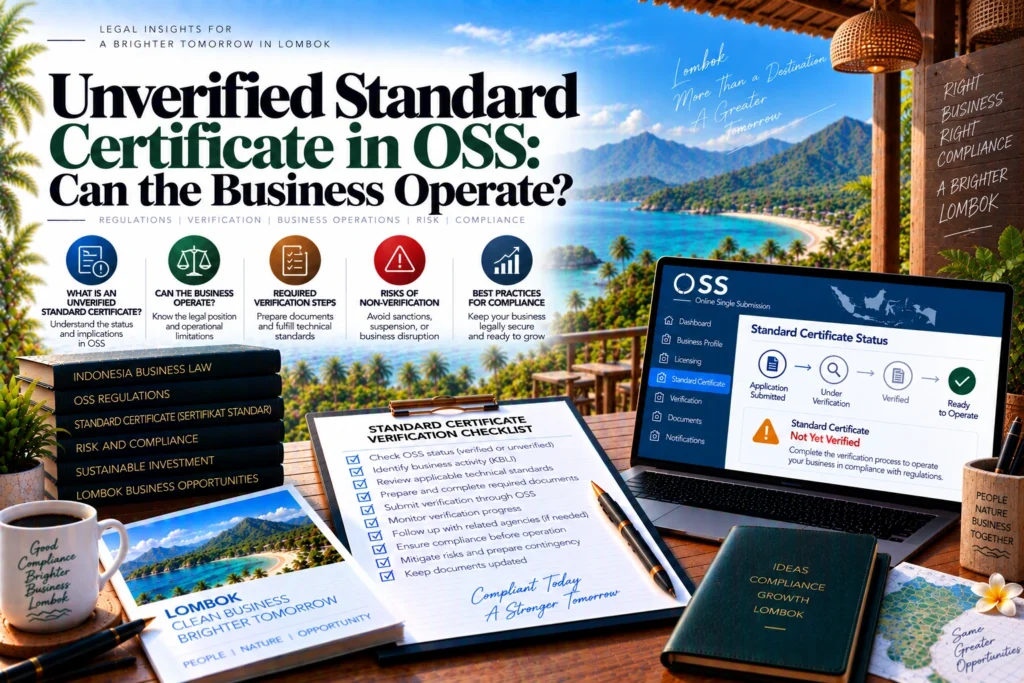
Unverified Standard Certificate OSS: Can the Business Operate?
For unverified standard certificate OSS, the direct answer for the medium-high-risk pathway is no, not for operational or commercial activity while the certificate remains unverified.
For medium-high-risk activities, Article 189 provides that OSS issues an NIB and a Standard Certificate marked as not yet verified after the required declarations are submitted.
The practical mistake is therefore to see two documents in OSS — an NIB and a Standard Certificate — and assume that the business is fully ready to open. For medium-high risk, the status written on the Standard Certificate changes its legal effect.
What an Unverified Standard Certificate Actually Means
An unverified certificate shows that the business has entered the medium-high-risk licensing process, but the business-standard verification stage is not yet complete.
This makes the certificate an intermediate compliance status, not simply a document waiting for an administrative label to change.
The NIB Can Be Issued Before Verification Is Finished
NIB issuance should be checked separately from Standard Certificate status. The presence of an NIB does not turn an unverified medium-high-risk certificate into verified operational licensing.
That distinction is especially important in acquisitions. A buyer may receive an OSS file showing an active NIB and a downloadable Standard Certificate, but the due-diligence question is whether the relevant activity’s Standard Certificate is still unverified, under correction or already verified.
Where the underlying problem instead concerns whether the location meets the applicable Basic Requirements, Lombok Legal ID’s Spatial Conformity OSS Indonesia guide covers the separate location-readiness question.
Preparation Is Different From Commercial Operation
Preparation and commercial operation should not be treated as interchangeable phases.
The regulation gives an unverified medium-high-risk certificate limited legality for preparation. It expressly prevents that certificate from being used to conduct operational or commercial activity until the required verification pathway is completed.
For planning purposes, the owner should therefore identify the intended commercial launch date and work backward from the outstanding standards, evidence and verification process rather than assuming that the date of NIB issuance is the operating date.
What Must Happen After the Certificate Is Issued?
The next step is not passive waiting.
Under Article 190, a business holding an unverified Standard Certificate must submit fulfilment of the applicable business standards through OSS.
The exact evidence depends on the activity and its sector standards. The business should open the relevant activity in OSS, identify the standard requirements and prepare evidence that corresponds to the actual project rather than copying a checklist used by another company.
The current OSS portal also maintains a dedicated medium-high- and high-risk Business Licensing application guide, reinforcing that the higher-risk application and fulfilment workflow is handled separately from simpler licensing routes.
OSS Notifications Do Not Replace Standard Fulfilment
The system can remind the business that fulfilment remains outstanding, but a notification is not the same as approval.
Article 190 further provides that OSS sends notifications concerning fulfilment of the standards when the unverified certificate is issued, 30 days after issuance, and/or 60 days before the estimated start of operational or commercial activity.
Owners should use those reminders as compliance checkpoints. If the intended launch is approaching while the certificate remains unverified, the correct response is to review the outstanding standards and verification status, not to assume that time alone will convert the certificate into operational legality.
Verification Can Be Approved, Corrected or Rejected
Submitting documents does not itself mean the certificate has been verified.
During verification, Article 192 provides that the competent verifier may approve the fulfilment of business standards, return it for correction, or reject it.
Where corrections are requested, the business should respond to the actual verifier comments rather than merely re-uploading the same evidence.
If the required corrections are not submitted within the Article 192 correction process or the fulfilment is rejected, Article 192 provides for OSS to revoke the unverified Standard Certificate.
That consequence is another reason to treat unverified status as an active compliance stage requiring follow-up.
When Can the Business Operate Commercially?
The key milestone is verified status.
After the applicable approval process is completed, Article 195 provides for OSS to issue the Standard Certificate marked as verified and states that the verified certificate is the legality for operational or commercial activity.
Before launch, the owner should therefore check the live activity record and the certificate itself rather than relying on an old screenshot, email or document downloaded before verification finished.
The verified status should also correspond to the activity that will actually operate. A verified Standard Certificate for one KBLI should not be assumed to resolve a separate activity merely because both sit under the same company NIB.
Readers dealing with an activity classified as high risk should not apply this Standard Certificate route to an Izin-based activity; Lombok Legal ID’s High Risk OSS Licensing Indonesia guide covers that separate licensing pathway.
Pre-Launch Checklist for Owners and Investors
First, identify the exact business activity and risk level. Confirm that the activity being reviewed is actually medium-high risk and uses the Standard Certificate verification route.
Second, open the current OSS activity record. Do not rely only on the company-level NIB. Check the specific Standard Certificate attached to the activity and read whether its status is unverified or verified.
Third, review the applicable Basic Requirements. Location, environmental or other project requirements should be reconciled with the same activity and project that will operate.
Fourth, identify every outstanding business standard and supporting item. Prepare evidence based on the actual operation, premises, technical setup and sector requirements.
Fifth, submit the required fulfilment through OSS and track verifier feedback. If corrections are requested, address the substance of those comments within the applicable process.
Sixth, check the final status immediately before commercial launch. The operational decision should be based on the current verified certificate and activity record, not simply on the fact that the NIB and an earlier certificate were already issued.
For an acquisition, repeat the check against what is happening on site. A seller may describe the business as licensed while the OSS record still shows an unverified certificate for the activity that generates revenue.
Common Unverified-Certificate Mistakes
The first mistake is assuming that NIB issuance means all licensing stages are complete.
The second is treating a downloadable Standard Certificate as operational approval without checking whether it says verified or not yet verified.
The third is waiting for the status to change without submitting fulfilment of the business standards.
The fourth is ignoring verifier correction notes and assuming the original submission is sufficient.
The fifth is confusing the medium-high-risk Standard Certificate pathway with the high-risk Izin pathway.
The sixth is checking only the legal entity and not the individual activity. A company can have several activities with different licensing and verification statuses.
This review focuses on the pre-launch operating decision. For the application sequence and supporting evidence, use the Standard Certificate verification guide; check the basic business-licensing requirements guide separately where the project also has unresolved location, environmental or building-readiness issues.
Conclusion
An unverified Standard Certificate in OSS is not the same as verified operational licensing. In the medium-high-risk pathway, it provides limited legality for business preparation while the applicable standards still need to be fulfilled and verified.
The operating decision should therefore be status-based: identify the activity, submit the standards, respond to verification, and confirm that OSS has issued the Standard Certificate as verified before relying on it for operational or commercial activity.
Confirm the OSS Status Before Commercial Launch
If your business in Lombok has an NIB but the Standard Certificate is still unverified, Lombok Legal ID can be consulted to review the activity, outstanding standards and wider OSS licensing position before commercial operations begin.
If the same investment also involves purchasing, leasing or developing land and ownership documentation needs separate due diligence, the verified PPAT property-document service can be reviewed as a separate property-related step; it is not part of Standard Certificate verification itself.
For help coordinating the company records and supporting documents discussed here, review our Business Setup service and agree the scope for your project.
Read Also: Company Setup Guide in Lombok: Entity Choice, OSS and Launch Planning
FAQ Unverified Standard Certificate OSS
Can a business operate with an unverified Standard Certificate?
For the medium-high-risk pathway discussed here, no. The current implementing regulation limits NIB plus an unverified Standard Certificate to business preparation and states that it cannot be used for operational or commercial activity.
Does having an NIB mean the business may already operate?
Not necessarily. For a medium-high-risk activity, the Standard Certificate status must also be checked because an unverified certificate has a different legal effect from a verified one.
What should a business do after receiving an unverified Standard Certificate?
The business must submit fulfilment of the applicable business standards through OSS and follow the verification process for that activity.
Can the verifier ask for corrections?
Yes. The current process allows fulfilment of the business standards to be approved, returned for correction or rejected.
What happens if the business standards are rejected?
Under the current implementing regulation, rejection or failure to complete the required correction process can result in revocation of the unverified Standard Certificate.
When does the Standard Certificate support commercial operation?
After the applicable approval process results in OSS issuing the Standard Certificate as verified; the current regulation identifies that verified certificate as the legality for operational or commercial activity.
References & Sources
- Government Regulation No. 28 of 2025 — Risk-Based Business Licensing — peraturan.bpk.go.id
- Minister of Investment/BKPM Regulation No. 5 of 2025 — Official Legal Record — jdih.bkpm.go.id
- Minister of Investment/BKPM Regulation No. 5 of 2025 — Official Regulation PDF — jdih-storage.bkpm.go.id
- OSS Guide — Medium-High and High-Risk Business Licensing Application — oss.go.id